Essential to our bodies, vitamins are often cited as the building blocks of our health. Numbering 13, vitamins are involved in numerous physiological processes.
They are classified into two categories according to their chemical nature. Water-soluble vitamins, which are found in the bloodstream, include the eight B vitamins and vitamin C. Fat-soluble vitamins include vitamins A, D, E, and K. Our body is able to store these vitamins in the liver and adipose tissue.
In this article, we present the vitamins, with a focus on fat-soluble vitamins, vitamins A, D, K and E: their benefits, the necessary intake for our good health, the risks of deficiencies, and their food sources.
What are vitamins?
Vitamins are essential organic elements for the proper functioning of our body. They are unique in that they are needed in very small quantities to maintain our health.
Overall, we must obtain vitamins from our diet, as our body cannot produce them on its own, with the exception of two of them, vitamins D and K.
Vitamins have no energy value, meaning they are not caloric. And for each vitamin, there are nutritional reference values indicating the target daily amount for our health (RNI: Reference Intake for the Population or AI: Adequate Intake).
The functions of vitamins in the body
Vitamins are essential for the proper functioning of several physiological mechanisms. We can define two categories of benefits that vitamins provide to our body:
A structural role : vitamins are essential for several structural elements of our body such as the growth and health of our bones, various cellular activities, the formation of our tissues and skin...
A functional role : beyond their involvement in the structure of our body, vitamins ensure the proper functioning of numerous systems such as the nervous system, the muscular system, the immune system, and the cardiovascular system. They are also involved in DNA synthesis, vision, digestion, and more.
Fat-soluble vitamins: vitamin A
Vitamin A is also commonly called retinol. It has a precursor, provitamin A (pro-retinol), which is found in the large family of carotenoids, the best known of which is beta-carotene.
The functions of vitamin A:
Immune system : Vitamin A contributes to the normal function of the immune system.
Vision : Vitamin A contributes to the maintenance of normal vision.
Cellular activity : Vitamin A plays a role in the process of cell specialization.
Iron metabolism : Vitamin A contributes to normal iron metabolism.
Skin and mucous membrane health : Vitamin A contributes to the maintenance of normal skin. Vitamin A contributes to the maintenance of normal mucous membranes.
The risks of a vitamin A deficiency:
Intrauterine and postnatal growth delays, congenital malformations, dry eye, loss of night vision.
Reference intakes for vitamin A:
Value: RNP (Reference Intake for the Population)
Adult male: 580 μg/day
Adult woman: 490 μg/day
Pregnant woman: 540 μg/day
Breastfeeding woman: 1020 μg/day
Sources of vitamin A:
Foods of animal origin:
Cod liver oil (30,000 μg / 100 g), offal and liver (14,500 to 4,000 μg / 100 g), fish (1,100 to 285 μg / 100 g), butter (800 μg / 100 g), fresh cream (390 μg / 100 g), cheeses (265 to 350 μg / 100 g), eggs (230 to 450 μg / 100 g).
Plant-based foods:
Sweet potato (10,500 μg / 100 g), carrot (7,200 μg / 100 g), squash (6,900 μg / 100 g), salads (5,300 μg / 100 g), spinach (4,000 μg / 100 g), apricot (2,100 μg / 100 g), melon (1,900 μg / 100 g), tomato (1,600 μg / 100 g), red pepper (1,500 μg / 100 g), mango (1,200 μg / 100 g).
Fat-soluble vitamins: vitamin D
Vitamin D is one of the two vitamins our body can synthesize. It has hormonal activity and exists in two forms: D2, called ergocalciferol, which is of plant origin, and D3, called cholecalciferol, which is primarily of animal origin. Sun exposure (15 to 20 minutes is sufficient) allows the synthesis of vitamin D3 in the epidermis of our skin.
The functions of vitamin D:
Bone health: Vitamin D contributes to the maintenance of normal bones. Vitamin D also contributes to normal blood calcium levels (serum calcium).
Cellular activity: Vitamin D plays a role in cell division.
Muscular system: Vitamin D contributes to the maintenance of normal muscle function.
Immune system: Vitamin D contributes to the normal function of the immune system.
Pregnancy and Children: Vitamin D is necessary for normal growth and bone development in children.
The risks of vitamin D deficiency:
A vitamin D deficiency reduces bone density, weakening our skeleton and potentially contributing to osteoporosis. This deficiency leads to an alteration in the bone mineralization process, resulting in rickets in children and osteomalacia in adults.
Reference intakes for vitamin D:
Value: AS (Satisfactory Contributions)
Adult male: 15 μg/day
Adult woman: 15 μg/day
Pregnant women: 15 μg/day
Breastfeeding woman: 15 μg/day
Sources of vitamin D:
Foods of animal origin:
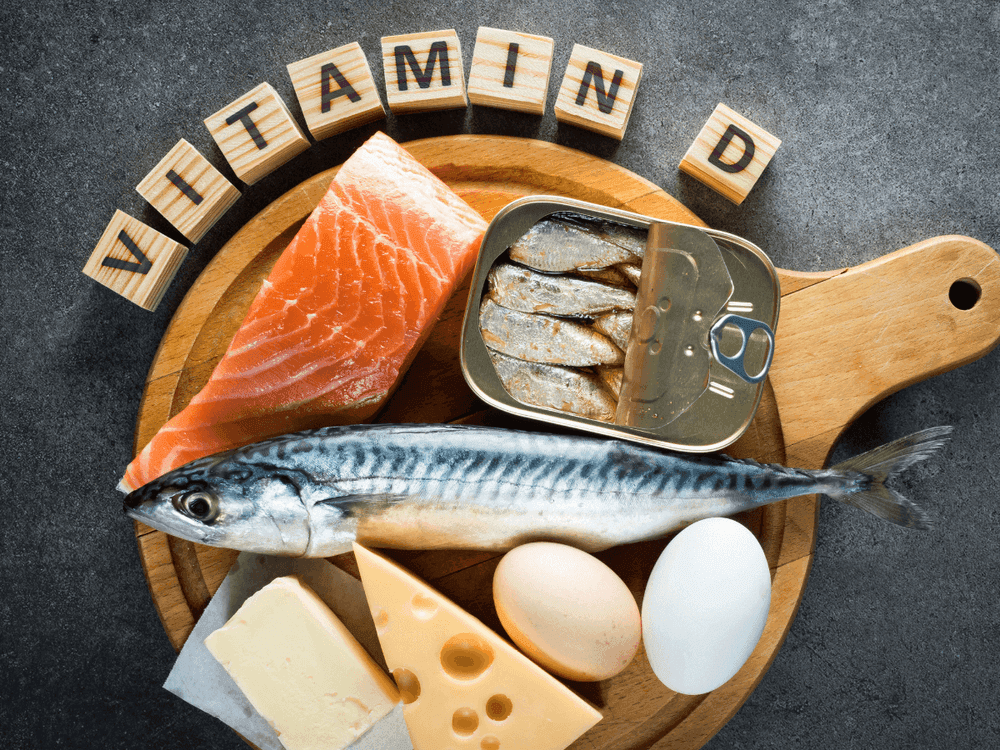
Cod liver oil (250 μg / 100 g), cod liver (54 μg / 100 g), fish roe (cod and salmon - 27 μg / 100 g), herring (22 μg / 100 g), fish (halibut, tilapia, trout, swordfish – between 21 and 15 μg / 100 g).
Plant-based foods:
Vegetable fats such as margarine (7.5 μg / 100 g).
Fat-soluble vitamins: vitamin E
Vitamin E comprises several compounds with antioxidant properties: tocopherols (alpha, beta, delta, and gamma) and tocotrienols (alpha, beta, delta, and gamma). Through its antioxidant action, it helps preserve the body by slowing down aging.
The functions of vitamin E:
Cellular activity: Vitamin E helps protect cells against oxidative stress. This makes it beneficial for preserving cognitive function, as well as muscle mass and recovery.
The risks of a vitamin E deficiency:
A vitamin E deficiency can lead to neurological degeneration.
Reference intakes for vitamin E:
Value: AS (Satisfactory Contributions)
Adult males: 10 mg/day
Adult women: 9 mg/day
Pregnant women: 9 mg/day
Breastfeeding women: 9 mg/day
Sources of vitamin E:
Plant-based foods:
Wheat germ oil (149 mg / 100 g), sunflower oil (57 mg / 100 g), avocado oil (45 mg / 100 g), vegetable fats such as margarine (23 mg / 100 g), olive oil (22 mg / 100 g).
Foods of animal origin:
Cod liver oil (30 mg / 100 g).
Fat-soluble vitamins: vitamin K
In humans, vitamin K includes vitamins K1 (phylloquinone) and K2 (menaquinone).
The different roles and functions of vitamin K:
Cellular activity : Vitamin K (K1) contributes to normal blood clotting.
Bone health: Vitamin K (K2) contributes to the maintenance of normal bones.
The risks of a vitamin K deficiency:
A dietary deficiency in vitamin K is rare and can lead to poorer lipid absorption.
Reference intakes for vitamin K:
Value: AS (Adequate Intake) for vitamin K1 (little data exists on K2 requirements).
Adult male: 79 μg/day
Adult woman: 79 μg/day
Pregnant woman: 79 μg/day
Breastfeeding woman: 79 μg/day
Sources of vitamin K:
Vitamin K1 - Plant-based foods:
Dried herbs (basil, sage, thyme, parsley – 1200 to 1700 μg/day), kale (820 μg/day), spinach (500 μg/day), soybean oil (360 μg/day), Brussels sprouts (200 μg/day), broccoli (180 μg/day).
Vitamin K2 - Foods of animal origin:
Goose liver (360 μg/100 g), chicken (34 μg/100 g), raw egg yolk (32 μg/100 g), the
butter (15 μg / 100 g).
Other vitamins are also essential to our health; these include water-soluble vitamins, the B vitamins (B1, B2, B3, B5, B6, B8, B9, B12), and vitamin C. Absorbed in the small intestine, they are not stored in our bodies. Blood circulation allows them to reach their sites of action where they are directly used.
A varied diet, rich in fruits and vegetables, with appropriate protein intake, and cereals helps to support our different vitamin needs.